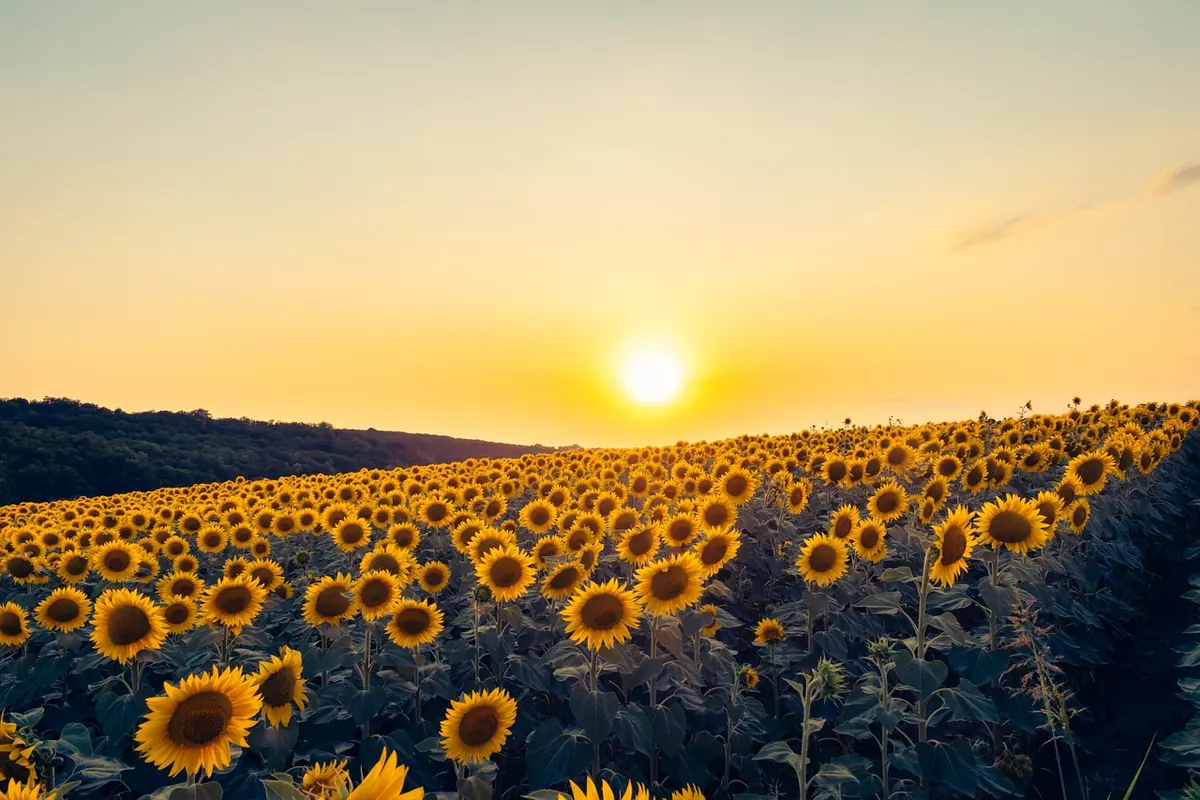
By the middle of August, the yellow flowers have taken over. Roadsides go gold, garden beds lean under their own weight, and half the neighborhood seems to have a sunflower standing in it like a guest who arrived early and never left.
That is usually the moment the question comes up: is this a sunflower, or a black-eyed Susan? The two get mixed up constantly, and it is easy to see why. Both are members of the daisy family, both hold up a ring of yellow petals around a dark center, and both hit their stride in the same few weeks of late summer. But they are different plants with different habits, and once you know which four features to check, you can separate them from across a fence — or from a moving car, which is how most of us do it.
Start With the Silhouette
Before you look at a single petal, step back and take in the whole plant.
A sunflower (Helianthus annuus) usually reads as an event. One stout, hairy stem climbs fast — often waist-high by July and head-high or taller by August — carrying a single enormous flower. The stem is thick enough that you notice it, and the whole thing looks slightly top-heavy, because it is. Branching types exist and are worth growing, but even they keep the same architecture: heavy stems, big leaves, flowers measured in hand-spans.
A black-eyed Susan (Rudbeckia hirta and its relatives) reads as a drift. Slender stems rise from a clump, branch loosely, and carry many small flowers at once. Plants typically land somewhere between knee and chest height, and they have a relaxed, slightly sprawling posture. After a hard rain, some of them will be lying on the ground. That is not failure; it is just what they do.
So: one giant flower on a thick stem, or a dozen modest ones on wiry stems? That alone settles most identifications.
Petals: Broad Sails, Narrow Ribbons
Those yellow "petals" are ray florets, and their shape is the second reliable clue.
Sunflower rays are wide and rounded, often overlapping like shingles, with a soft curve at the tip. They feel substantial between your fingers — almost like a strip of thick fabric. On most single varieties they form one generous ring, though doubles and semi-doubles exist that blur the rule. The color runs from pale lemon to deep gold, sometimes with a darker flush where the petal meets the center.
Black-eyed Susan rays are narrow and strap-like, with a pointed or slightly notched tip. Leave room between them: on many plants you can see green sepals peeking through the gaps at the edge of the head. They twist and droop a little, especially as the flower ages, and they have a thin, papery feel. The color usually leans warmer than a sunflower — golden-orange rather than pure yellow — and often deepens to a brownish-orange right at the base.
A quick test in the hand
Run a thumb along a petal. Broad, plush, and rounded means sunflower. Narrow, flat, and a little stiff means black-eyed Susan.
The Center: Flat Saucer or Raised Dome
The center is where the two plants look least alike, and it is the feature people most often overlook.
A sunflower's disc is large and flat to slightly concave — frequently a third or more of the entire head's width. It starts greenish, turns chocolate brown to near-black, and fills with tiny florets that open in rings from the outside inward, which gives it a subtle spiral texture. If you leave the head on the stem, the seeds that follow are big, fat, and striped. The weight of a ripening head will pull the whole thing downward.
A black-eyed Susan's center is a raised, hard cone. It genuinely protrudes, like a thimble pushed up through the petals, and it stays small relative to the flower. Rub it and it feels firm rather than soft. The seeds inside are tiny and dark, and the cone often darkens and elongates further as it matures.
Flat and broad: look up. Raised and tight: look down at a cone.
Leaves and Stems: Sandpaper or Straps
When the flowers are past their best, leaves take over the job.
Sunflower leaves are big, roughly heart- or spade-shaped, and coarse. They are covered in stiff hairs that make them feel like fine sandpaper, they are arranged alternately up the stem, and the lower ones can be wider than your outstretched hand. The stem is thick, bristly, and sometimes spotted with purple.
Black-eyed Susan leaves are narrow and lance-shaped, usually five to ten centimetres long, with three noticeable veins running lengthwise. By flowering time most of the foliage sits in a low clump at the base of the plant, and the leaves up the stem are small and sparse. The stem is slender and lightly hairy.
Other Yellow Faces You Might Be Seeing
Neither plant exists in a vacuum, and a few others crowd into the same window of the season:
- Heliopsis (smooth oxeye): looks like a small sunflower, but the leaves are smooth rather than rough, and the stems are sturdier and more upright.
- Perennial sunflowers such as Helianthus maximiliani: tall and narrow, with many small flowers stacked along the stem, blooming later than the annual kinds.
- Cutleaf coneflower (Rudbeckia laciniata): a relative of the black-eyed Susan with divided leaves and a greenish, drooping cone.
- Mexican hat (Ratibida columnifera): unmistakable once seen — the center is a tall brown cylinder with petals swept back from it.
- Coreopsis: smaller in every dimension, often with a notched or fringed petal tip.
A Sixty-Second Field Check
- Look at the plant from three metres away. Single huge head on a thick stem, or many small heads on thin stems?
- Squint at the center. Is it flat and wide, or a raised hard cone?
- Examine a petal tip. Rounded and broad, or narrow and pointed?
- Check for gaps. Can you see green between the petals at the rim?
- Feel a leaf. Sandpaper-rough and hand-sized, or narrow with three veins?
- Note the height and posture. Towering and upright, or waist-high and loose?
Three or more answers pointing the same way and you can stop looking.
Living With the Difference: Late-Summer Notes for a Slow Garden
Knowing which plant you have changes how you care for it, and late summer is exactly when that matters.
Sunflowers are quick, hungry annuals with deep taproots. They resent being moved once established, so sow them where they are to stay. Tall varieties need shelter from wind or a discreet stake before the heads fill out — tie loosely, and check the ties as the stems thicken. Leave the finished heads on the plant and the birds will do the cleanup for you; the stripped husks are one of the season's small satisfactions. For the vase, cut stems in the morning when the first petals are just unfurling, strip the lower leaves, and change the water daily.
Black-eyed Susans are the more forgiving of the two. They tolerate poorer soil, seed themselves around with cheerful persistence, and reward deadheading with a second and third flush of flowers well into September. If they flop, shear the whole clump back by a third after the first wave and it will come back shorter and denser. Leave a few cones standing through autumn — goldfinches will find them. Lift and divide crowded clumps in spring, and pull seedlings from paths and gravel before they settle in.
The pleasant part is that you do not have to choose. A tall sunflower at the back of the border with a drift of black-eyed Susans in front gives you both the architecture and the haze. And next August, when someone slows down at the gate and asks which is which, you will be able to tell them in a sentence.
Photo: niki_emmert / Pixabay