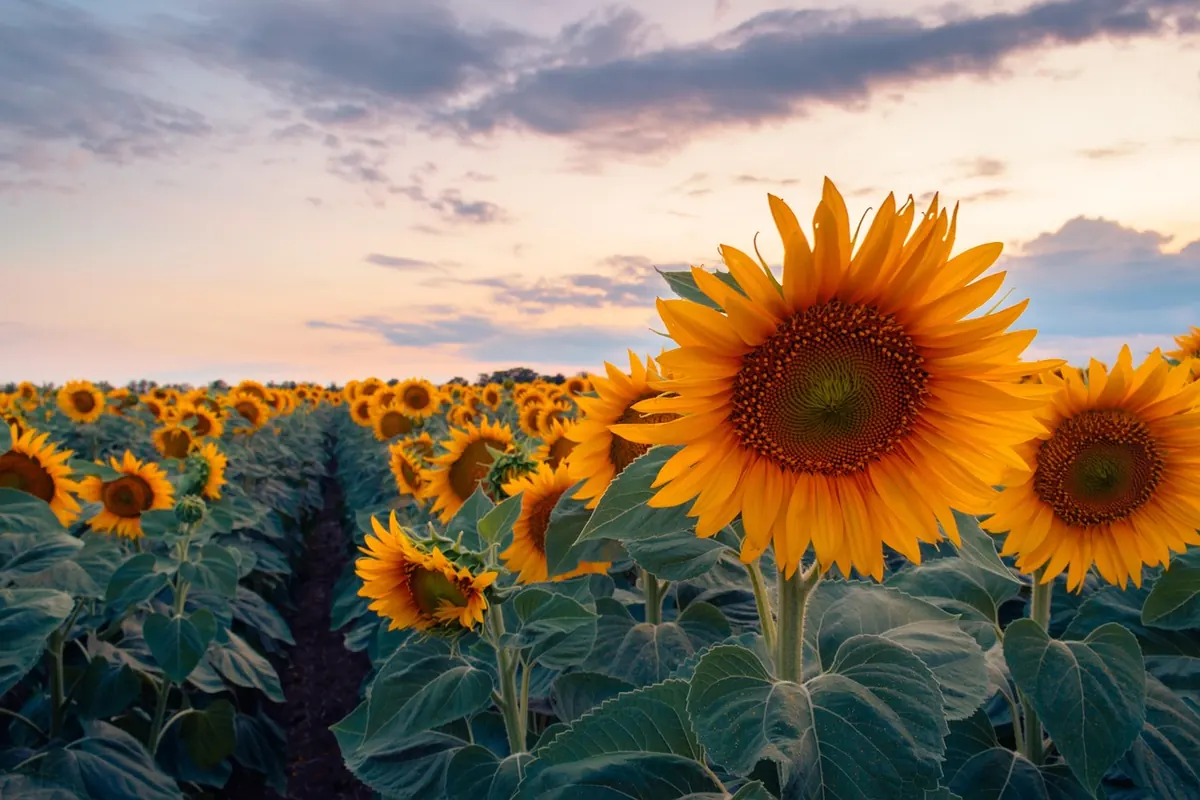
Midday has a reputation. Photographers pack up at eleven, mutter something about contrast, and promise themselves they will come back at golden hour. Sunflowers get caught in the middle of that argument. The light is stubborn, not the flower, and the hours around noon are often the ones when you have the field to yourself, the sky is a deep clean blue, and nobody is standing in your frame. What follows is how to work with overhead sun instead of waiting it out — how to keep yellows from turning into flat plastic, how to make black shadows into shapes rather than problems, and how to leave with files you actually want to edit.
Why Overhead Sun Is So Hard on Yellow
The technical problem is range. At noon the lit tops of the petals can be several stops brighter than the shaded undersides and the leaves below, and a camera cannot hold both comfortably. The aesthetic problem is scale: a small, hard light source directly above the subject produces small, hard shadows that read as clutter rather than form.
Yellow makes it worse. It is the brightest saturated colour in the scene, and it is built from strong red and green channels. Those channels can hit the ceiling while the luminance histogram still looks comfortable, which is how you end up with petals that look like cut paper: no veins, no translucency, no texture. A small shift in exposure fixes it, but only if you are looking for it.
One more thing worth knowing before you raise the camera. Young sunflowers track the sun across the sky, but mature heads mostly settle facing east. At midday you are often standing beside or behind the flower, photographing the side of the head rather than the face of it. Turn that into the plan rather than fighting it: work the edges, the bracts, the hairy stem, the profile silhouette.
Expose for the Petals and Protect the Yellow
Start by switching off the flattering lie of the rear screen. In bright sun the LCD looks washed out and dim at the same time, and it will convince you that a slightly hot frame is fine. Use the histogram instead, and turn on the highlight warning if your camera has one.
Meter for a mid-tone petal rather than the whole scene. Spot metering on the lit petal and then dialling in roughly minus two-thirds of a stop is a reliable starting point. Then check the colour histogram, not just the brightness one, and pull the exposure back until red and green stop touching the right edge. An underexposed sunflower can be lifted in a raw file and still look like a flower. A clipped one cannot be recovered into anything but a flat yellow shape.
Shoot raw. Midday files usually need a little highlight recovery and a gentle pull on the yellow luminance, and raw gives you room for both without the petals turning to mush. If you are working in JPEG only, err brighter on the shadows and darker on the highlights; you can always lift the dark side, but you cannot put texture back into a blown petal.
Put the Sun Behind the Flower, or Move Your Feet
Front-lit at noon is flat. The light comes straight down, the face of the flower is evenly lit, and the picture has no opinion. Two positions rescue it.
The first is backlight. Stand so the sun is behind the head and let the flower block the disc — carefully, and never look at the sun through the viewfinder. The petals go translucent, the fine hairs on the stem and bracts light up as a bright outline, and the centre falls into a rich dark disc. Meter for the petals and let the middle go, because that contrast is the picture. If flare softens the whole frame, hold a hand or a hat just outside the top of the lens, or use a proper hood.
The second is a low angle. Kneel, or lie on your side in the dirt, and shoot upward so the flower sits against sky rather than soil. This solves two problems at once: the bright background goes clean and even, and the hard overhead shadow moves behind the subject where it stops competing for attention.
Treat Shadows as Structure
A noon shadow is a graphic element. Long, crisp lines across dry soil, the repeated arcs of leaf shade, the black wedge a stem throws — these are composition material, not something to be softened away with a slider. Look for patterns before you look for single flowers.
The simplest trick is isolation. Find a head that is lit while everything behind it is in shadow, then expose for the light. The yellow arrives with enormous force against dark green or dark earth, and the messy background disappears without any editing. Crop tighter than feels natural. Fill the frame with one third of a flower and let the shadow do the rest.
Shape the Light You Already Have
You do not need a studio, but two cheap items earn their space in the bag on a bright day. A folding translucent diffuser, roughly 60 to 80 centimetres across, held between the sun and the flower, turns hard overhead light into something soft enough to show petal veins. A white board, a car sunshade, or a sheet of foam core bounced underneath fills the black underside of the head. Both need a second pair of hands, a clamp, or a light stand you are willing to carry.
A few things worth packing for a midday session:
- A diffuser, for one flower at a time rather than whole fields.
- A small white reflector for the shaded underside of the head.
- A polarising filter, to deepen blue sky and cut the waxy glare on leaves. Watch the corners on wide lenses, where the effect can go uneven.
- A cloth to wipe pollen and dust off the lens and to shade the front element.
- Water and a hat. Noon in a sunflower field is not a gentle environment.
Settings and a Field Workflow
Midday is generous with shutter speed, so spend it on quality rather than speed. A short sequence that works in almost any field:
- Set base ISO, usually 100, and leave it there.
- Choose the aperture for intent: around f/8 for a whole head in focus, f/2.8 to f/4 to isolate one flower from a crowd.
- Focus with a single point on the edge of the seed disc, where the small florets give a crisp, high-contrast target.
- Spot meter on a lit petal, set minus two-thirds of a stop, and check the colour histogram.
- Bracket three frames a stop apart for any flower with petals catching a direct reflection.
- Re-check the histogram every twenty frames or so, because the sun moves and so do you.
One caution about focus: at midday, heat shimmer over a field can soften distant flowers even at small apertures. Work closer, or accept that the far heads are atmosphere rather than subject.
A Ten-Minute Check Before You Leave the Field
Before you pack up, run through four questions. Is the sun behind you or behind the flower, rather than directly above both of you? Does the colour histogram show clean yellows with no clipped channels? Is there a shadow in the frame doing real work? And are the edges clean — no half stems, no stray leaf poking into a corner?
Then put the camera down for a moment and look at where you have been standing. Stay on the paths and headlands, walk between rows rather than through them, and leave the flowers and the soil as you found them. A field is someone's work, and photographing it well includes not trampling the rows you came to admire.
Photo: niki_emmert / Pixabay